Physics fundamentals: A Complete Physics Learning Hub
Have you ever thought about why a truck causes more damage than a bike at the same speed? The answer lies in understanding the fundamentals of Physics. Physics can feel difficult at first—but it doesn’t have to be. Physics isn’t hard—you’ve just never seen it explained the way your brain actually understands.
Physics Fundamentals will turn confusion into clarity faster than anything you’ve studied before. At Physics Fundamentals Hub, we break down complex physics concepts into simple, clear, and easy-to-understand lessons designed for students, beginners, and exam preparation. Whether you’re learning motion, forces, energy, electricity, or modern physics, our goal is to help you truly understand physics—not just memorize it. Physics is not just a subject—it is the language of the universe.
What You Will Learn Here
Physics is the science that explains how the universe works—from falling apples to moving planets.
On this website, you will find:
We focus on learning + understanding + exam success.
Explore Core Physics Fundamentals Branches
Physics is divided into several important branches:
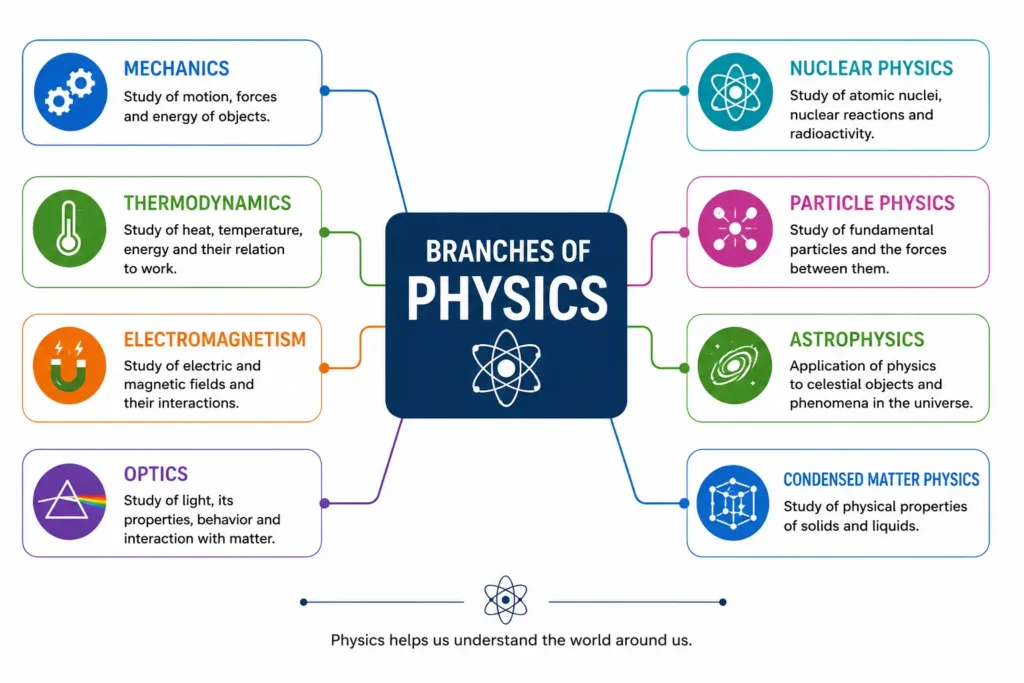
Mechanics (Motion and Forces)
Mechanics studies how objects move and the forcesacting on them.
Key topics:
Thermodynamics (Heat and Energy Transfer)
Thermodynamics explains how heat and energy move.
Key topics:
Electromagnetism (Electricity and Magnetism)
This branch studies electric charges and magnetic fields.
Key topics:
Optics (Light and Vision)
Optics studies the behavior of light.
Key topics:
Quantum and Modern Physics
This branch explains the behavior of matter at atomic and subatomic levels.
Key topics:
Fundamental Laws of Physics
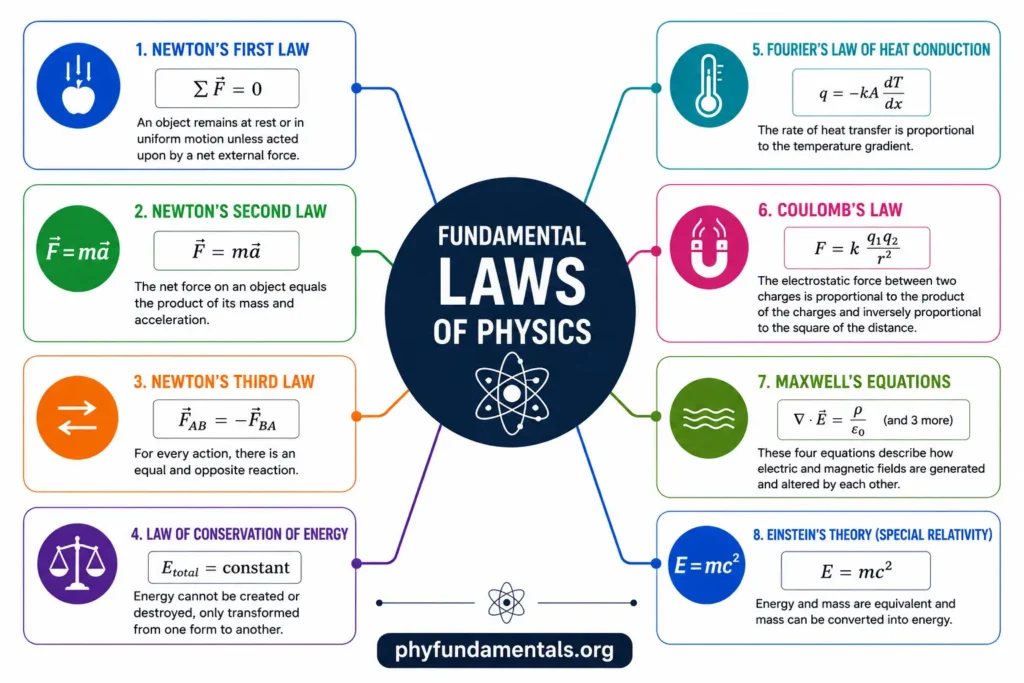
These are the most important laws that govern the universe:
Newton’s Laws of Motion
1. Objects stay at rest or motion unless forced
2. Force = mass × acceleration (F = ma)
3. Every action has an equal and opposite reaction
Law of Conservation of Energy
Energy cannot be created or destroyed, only transformed from one form to another.
Law of Conservation of Momentum
Total momentum before and after a collision remains constant.
Ohm’s Law
V = IR
Voltage = Current × Resistance
Laws of Thermodynamics
Einstein’s Theory of Relativity
E = mc²
Mass can be converted into energy.
Core Concepts in Physics Fundamentals
Force: A push or pull that changes motion.
Energy: Ability to do work.
Work: Work = Force × Distance
Power: Rate of doing work.
Momentum: Momentum = Mass × Velocity
Waves: Energy transfer without movement of matter.
Real-Life Applications of Physics
Physics is not just theoretical—it is deeply connected to everyday life.
Buildings, bridges, and machines rely on mechanics and material physics
Electricity generation and distribution depend on electromagnetic principles.
X-rays, MRI scans, and ultrasound imaging use physics concepts.
Mobile networks, Wi-Fi, and satellites use wave and signal physics.
Rocket launches and satellite motion rely on gravity and motion laws.
Without physics, modern civilization would not exist.Without physics, modern technology would not exist.
Physics Formula Cheat Sheet
Here are essential formulas:
|
Physical Quantity |
Formulas |
|---|---|
|
Force |
F=ma |
|
Energy |
E = mc² |
|
Waves |
v = fλ |
|
Work |
W = F × d |
|
Power |
P = W/t |
|
Kinetic Energy |
KE = ½mv² |
|
PE = mgh |
Potential Energy |
|
Electricity |
V = IR |
How to Learn Physics Fundamentals Easily
1. Understand concepts first
2. Do not memorize formulas without meaning.
1. Learn the basics step by step
2. Start with motion → energy → electricity → modern physics.
1. Practice numerical problems
2. Physics becomes easy with practice.
1. Use real-life examples
2. Relate physics to daily life situations.
Learn Physics Step-by-Step (Beginner Friendly Path)
If you’re confused about where to start, follow this order:
1. Motion and Laws of Motion
2. Force and Energy
3. Work and Power
4. Electricity Basics
5. Waves and Sound
6. Modern Physics
This path ensures strong conceptual foundation.
Practice Makes Perfect
Physics is not just reading—it is solving.
We provide:
Who Is This Website For?
This platform is perfect for:
Our Teaching Approach
We follow a structured learning method based on:
Real-world physics explanations
and examples.
Well-structured topic clusters aligned with academic syllabus patterns.
Accurate scientific concepts based on standard physics principles.
Clear explanations, no misleading shortcuts, and exam-focused accuracy.
Popular Topics Students Search For
You will find all of these topics explained in detail here.
Our Goal
Our mission is simple:
To make physics easy, visual, and understandable for every student, no matter their level.Physics is not difficult
We believe:
Conclusion
Physics Fundamentals form the foundation of all scientific understanding. From motion and energy to atoms and light, physics explains everything in the universe.
If you master the basics of physics, you can understand advanced science, engineering, and modern technology easily.
Physics is not just a subject—it is the key to understanding the universe.